Diné Bikéyah
By: Sierra Edd Dec. 18, 2015
The Diné people emerged into Glittering World (current world) and they set the boundaries with four mountains: Sisnaajiní (Blanca Peak), Tso’ dziil (Mount Taylor), Dook’o’osłííd (San Francisco Peaks) and Dibé nitsah (Mount Hesperus). The spirit beings who journeyed through the four worlds, evolved into their human shape, the Holy People. The Holy Peoples’ prayers and song created the Blessing way ceremony. This Blessing way ceremony is a central part of Navajo life in its concept of Hózhó. [1]

Image by Orbegay
HISTORY | CONTEXT
EARLY AGRICULTURE
Before European contact, Diné agriculture consisted of corn and squash. Other food sources came from gathering wild plants and hunting deer and other large animals. [1]
SHEEP HERDING
The introduction of sheep, goats, and horses added to the transformation of the Navajo people into a herding lifestyle and the expansion of their territory. The use of sheep became very important in creating a large textile industry of blankets, rugs, and clothing. Households, livestock up-keeping and the land were managed by the women of the family. Throughout the different seasons, Navajos would move with their herds of sheep or goats into the mountains and return the fields of corns and squash later. [1]
POST LONG-WALK
Upon returning back to Dinétah after the Long Walk, Navajo people struggled to regain their herds and revitalize their fields. During this period, the sheep population severely depleted. To help replenish the sheep population, Navajos obtained food elsewhere until their herds increased (1880s). [1]
TERMINATION | RELOCATION
Federal Livestock reduction program 1930s-40s: Livestock was an important part of Navajo recovery and economic development, however in the early 1900s, Navajo livestock led to overgrazing and soil erosion. Livestock population control was an issue presented in the 1928 Navajo Tribal Council meeting by U.S. government officials. Livestock taxation, of "fifteen cents per head on flocks of over 1,000 sheep," were enforced on Navajo livestock owners and the U.S. exterminated many livestock, and forcefully, "drove thousands of animals into side canyons." [2] Additionally compensation at trading posts for livestock went as low as $2.50 per horse. Today, unbranded horses still rounded up and taken to a border town auction. Proceeds from the sale allow the local grazing committee members to purchase subsidized purchases of vaccine for tribal members. Each year a livestock tally is conducted. Individuals are expected to abide and keep livestock to the set number stated in their grazing permit.
Relocation from 1950s-1970s promoted leaving the reservation to find jobs in urban cities like, Los Angeles and Chicago. Many Navajo people found work on railroads aside from agricultural business. [1]
SELF-DETERMINATION
In the contemporary landscape of the U.S. economy that encourages resource extraction, the Navajo Nation has utilized its natural Resources such as water, coal, and Natural gas, for economic sustainability. Among other major industries like coal mining, the Navajo Agricultural Products Industry (NAPI) is a agribusiness that seeks "to develop and manage a self-sustaining, profitable, culturally and environmentally sensitive farming and agricultural processing business for the benefit of the Navajo Nation, the Navajo workforce, and regional and national economies".
References
[1] Denetdale, Jennifer. The long walk: The forced Navajo exile. Infobase Publishing, 2009.
[2] The Navajo Indians and Federal Indian Policy. by Lawrence C. Kelly. Tucson, Arizona: University of Arizona Press, 1974: p. 112.
Navajo Livestock Reduction: A National Disgrace. Navajo Community College, 1974: p. 24. http://library.nau.edu/speccoll/exhibits/indigenous_voices/navajo/livestock.html

Interdisciplinary Philosophy | Hózhó Nahazdlii’

Larry Emerson
Dr. Larry Emerson is from the Tsedaak’aan Chapter of the Navajo reservation (near Shiprock). He had his undergraduate education at Diné College, the University of New Mexico, and Fort Lewis College. He received his M.A. at San Diego State University, and his PhD. at Claremont Graduate University. His dissertation entitled, "Hózhó Nahazdlii’ Towards a Practice of Diné Decolonization" is about decolonization for Diné people. Emerson's work has been published in "Diné Perspectives: Revitalizing and Reclaiming Navajo Thought."
Image from Shiprock exchange.
Hózhónigo nashado nishłį́ Nááná
Emerson's work draws upon traditional concepts of the Blessing Way. His scholarship questions the forms of academic discourse and research which are based on 'colonist' knowledge and suggests complete decolonization at the local and global levels. He defines indigenous peoples as environmental refugees who have undergone systemic trauma alongside the land. Restoring Hózhó involves deconstructing resource industries and re-framing how Diné people interact with the environment with the concept of K'é. [1][2]
Diné Decolonization: Restoration of harmony and balance
-
K'é [kinship] with the earth, sky, plants, and animals
-
Restore traditional healthy foods [decolonial food sovereignty]
-
Restore traditional farming (gardens) and land restoration
-
Build homes using natural architecture
-
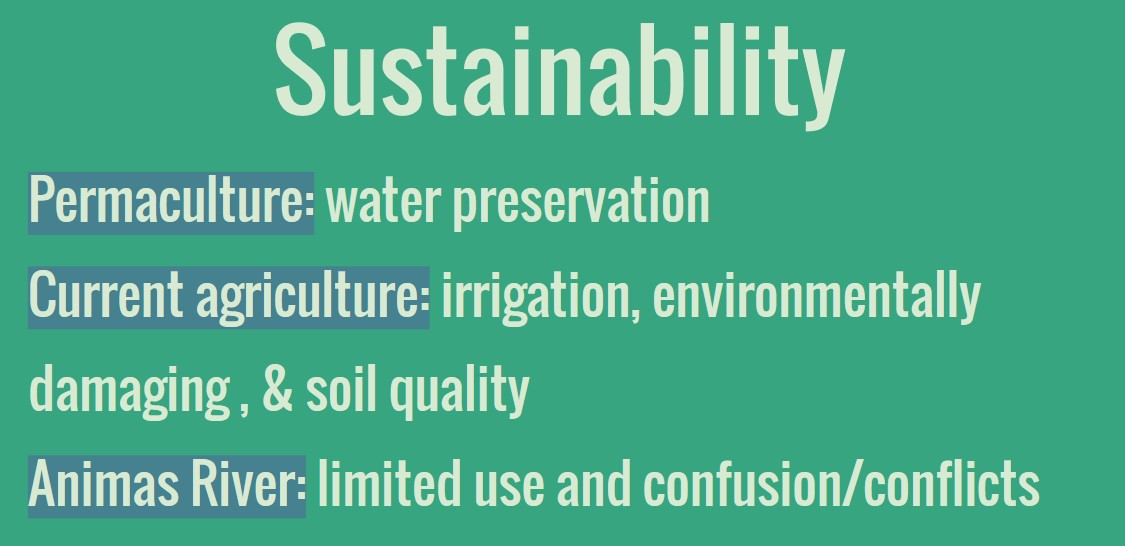
Building indigenous sustainability promotes better outcomes for the environment, whereas, large operations like the Navajo Agricultural Products Industry has damaged the soil, had limited profit that benefits Diné people, and consumes heavy quantities of water. [2]
-
Especially regarding contentious issues like the Gold King mine spill, which pose a threat to Navajo farmers who use the river water that has been contaminated, the need for alternative agricultural methods has onlybecome more relevant. [2]
-
There's a strong need for the application of traditional Diné thought into agricultural practices and livestock raising, as a part of a longer, extensive process of decolonization.
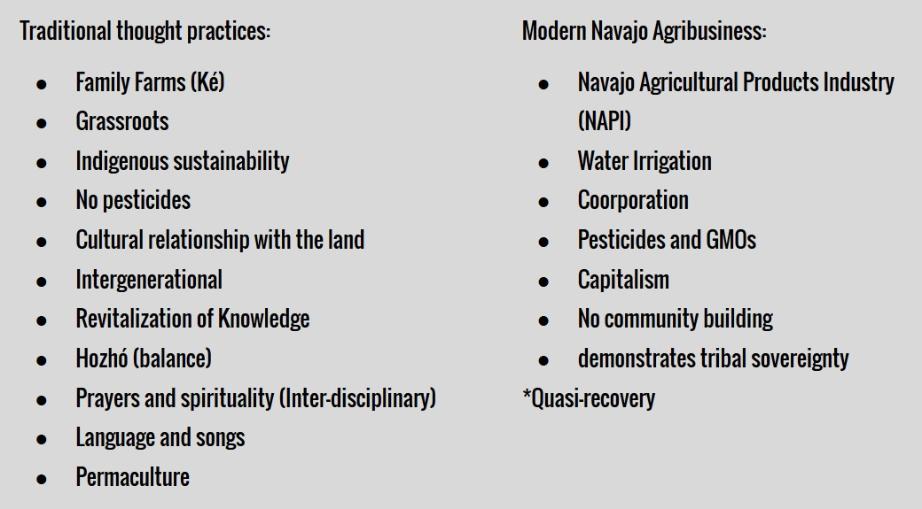
*Emerson further explains that Navajo agribusiness and other industries of resource extraction have been an impartial move by the Navajo Nation toward economic recovery or sustainability that appeals politically as self-determination but does not fully align with Diné philosophy.
References
[1]Cajete, Gregory. Diné Perspectives: Revitalizing and Reclaiming Navajo Thought. Edited by Lloyd Lance Lee. University of Arizona Press, 2014.
[2]Larry Emerson, phone interview, (Providence, RI) November 24, 2015.
